


OUR NEWS & socials
From a salty piece of no man's land to a thriving landscape
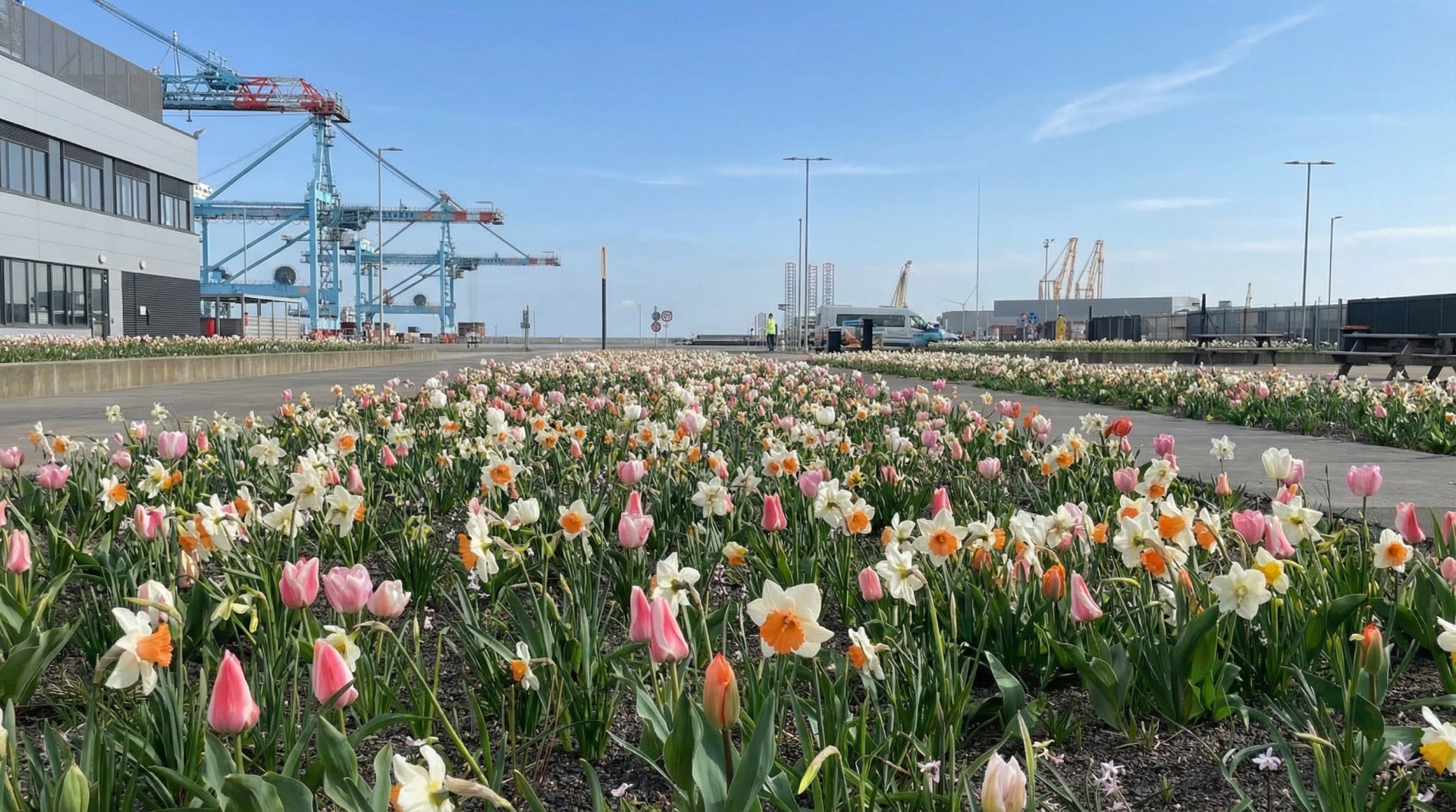
A Site-Specific Planting Strategy for All-Season Interest
At one of the most industrial sites in the Netherlands — Maasvlakte 2 in the Port of Rotterdam — a large-scale greening scheme has been realised. Between terminals, fencing and stacked containers, a prairie-style planting of flower bulbs and perennials now introduces seasonal colour, ecological value and cooling.
“We adapted our prairie bulb mixture specifically for this location,” says Otto de Vroomen of JUB Holland. “The selection had to withstand sea winds and lean soils.”
Maasvlakte is a landscape of extremes. The world’s largest container ships dock here, surrounded by concrete and steel. Yet APM Terminals, one of the principal operators on site, made a clear decision to invest in green infrastructure. Together with flower bulb specialist JUB Holland and perennial nursery Lageschaar, landscaping contractor Dijkman BV of Rockanje delivered a planting scheme in a setting where greenery is anything but obvious.
“This is a highly secured environment,” De Vroomen explains. “The brief was to create a more attractive setting for staff and visiting clients, while strengthening biodiversity.”
A Custom Bulb Mixture
JUB Holland supplied a bespoke bulb mixture aligned with the perennial planting provided by Lageschaar. “Within our broader landscape range, we offer bulb blends suitable for prairie-style applications,” says De Vroomen. “For this scheme, we refined both the species and colour composition to suit the conditions and the desired character. The result is a unique, site-specific mixture.”
Read all about climate adapive planting with flower bulbs ►
Designed for Saline Air and Poor Soils
Plant choice was decisive. “The bulbs needed to tolerate saline air and nutrient-poor ground,” De Vroomen explains. “We selected Hyacinthoides, Chionodoxa, naturalising tulips, Leucojum, several daffodil cultivars, Allium and Camassia. Together they create a flowering sequence lasting four to five months — from February through to June.”
A Structured Flowering Sequence
The planting was designed around succession. Early performers such as glory-of-the-snow and daffodils open the season, followed by tulips and later ornamental alliums.
“Once the bulbs finish, the prairie perennials take over,” says De Vroomen. “The visual character shifts, but the structure remains. Insects benefit from a continuous food source, and the site maintains a well-presented appearance throughout the growing season.”
Layered Structure
The scheme was implemented by Dijkman BV, part of GesselGroen.
“The concept focuses on creating green, healthy working environments,” says Gerard van Gessel, Managing Director of Gessel Groep.
Eight raised planting beds were constructed. Existing dune sand was removed and replaced with 50 cm of fertile topsoil. The bulbs were broadcast into the prepared layer, followed by an 8 cm mulch layer of Prairieva.
Prairieva is a lava-based aggregate that improves moisture retention, suppresses weeds and moderates soil temperature while maintaining a natural finish.
“In dry periods it can retain up to a third of its own weight in water,” Van Gessel explains. “During heavy rainfall the porous structure absorbs excess moisture, releasing it gradually during drier spells.”
The bulbs were selected for uniform planting depth, enabling installation in a single operation. In total, approximately 40,000 bulbs were planted.
Proven Coastal Performers
Lageschaar selected perennials capable of tolerating saline conditions and strong winds. "We have completed comparable coastal projects in recent years,” says Laurens Lageschaar. “We know which species perform. Artemisia, Armeria and various Achillea cope well here. Attempting to use Dicentra or Lamium would simply not succeed.”
Positive Response
The response from staff and visitors has been strong.
“Employees take their breaks here and appreciate the planting,” says Van Gessel. “The client has been very positive.”
“The combination of bulbs and perennials ensures seasonal interest from early spring well into autumn,” De Vroomen adds. “And that within a heavy industrial setting.”
A Model for Business Parks
The project demonstrates how industrial sites can integrate robust, climate-resilient planting.
“Prairie-style schemes tolerate heat and drought, buffer rainfall and help reduce surface temperatures,” says De Vroomen. “By integrating a carefully composed bulb mixture, you add early-season colour and ecological value — without increasing maintenance.”
Saline Air and Extreme Wind
Lageschaar also had to work within the environmental constraints of the site, selecting perennial species capable of tolerating saline air and persistent strong winds.
“In recent years we have completed comparable projects on the Maasvlakte and along the coast,” says Laurens Lageschaar. “That experience means we know exactly which species will perform — and which will not. Artemisia, Armeria and various Achillea cope well under these conditions. Attempting to plant Dicentra or Lamium here would simply not succeed.”
From Groundworks to Completion
According to Van Gessel, the success of the scheme lies in the close collaboration between all parties involved.
“Dijkman managed and delivered the project from the initial groundworks onwards,” he explains. “JUB Holland contributed its specialist expertise in flower bulbs, while Lageschaar provided in-depth knowledge of prairie-style perennial planting. Each partner brought their own discipline to the table. The shared objective was to achieve a well-presented landscape throughout the year — and together we accomplished that.”
This article was written by Fleur Dil and originally published in Stad + Groen


check out our socials


