


OUR NEWS & socials
JUB HOLLAND’S THE FIELD OF GOLD SHINES AT KEUKENHOF UNTIL 10 MAY
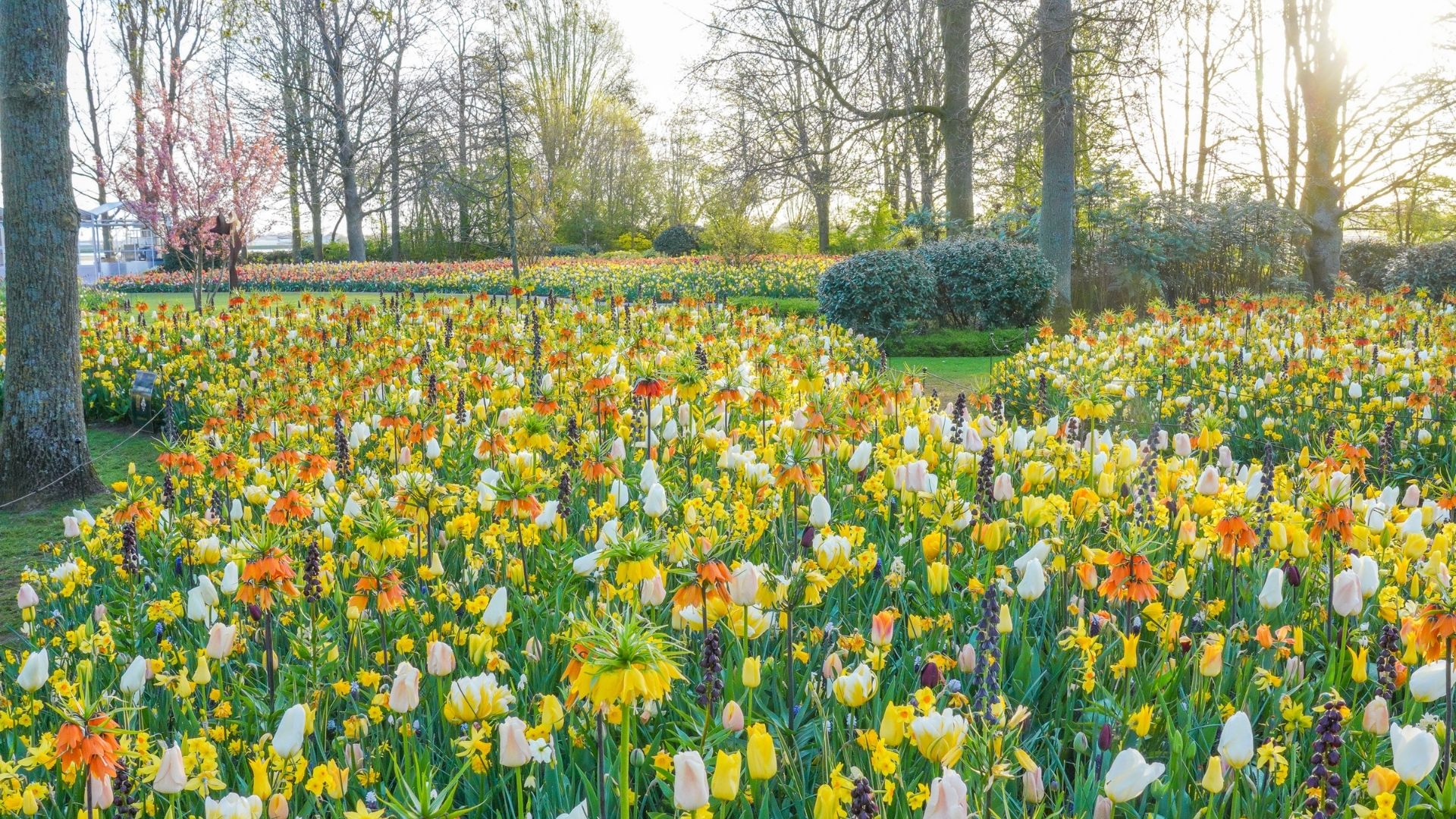
A layered golden border by Carien van Boxtel, inspired by Sting and Vincent van Gogh
Lisse, the Netherlands, 4 May 2026 – The Keukenhof season is drawing to a close. On 10 May, the gates of the international spring flower park in Lisse, the Netherlands will close once again. Until then, visitors still have the opportunity to experience The Field of Gold: JUB Holland’s entry for Keukenhof 2026. A long-flowering, layered border in which designer and RHS Bulb Expert Carien van Boxtel does not shy away from yellow, but instead gives it a confident leading role.
Inspired by Fields of Gold, the iconic song by Sting, and Wheatfield with Crows by Vincent van Gogh, Van Boxtel created a composition in which golden tones, shadow and seasonal movement come together. The result is a living painting that continually shifts in character throughout the season. At the same time, the border represents more than a temporary showpiece. As it does each year, JUB Holland translates the design into a practical bulb mixture for clients in the landscape and retail sectors. In this way, Keukenhof borders evolve into a collection that later reappears in parks, public green spaces, entrances, business grounds, private gardens and retail displays.
“Yellow is often an undervalued colour in gardens and planting schemes. That’s precisely why I wanted to explore it this year — not as something loud or overpowering, but as a carrier of warmth, light and emotion,” says Carien van Boxtel.
From a soft opening to a dramatic finale
The Field of Gold began this spring with delicate, fresh tones and an unusually early display of botanical tulips, crocuses, irises and daffodils. From the opening of Keukenhof, the JUB Holland border revealed its first flowering layers exactly as intended: building gradually towards a rich, multi-layered finale. As the season progressed, the palette deepened into richer golds, apricot, peach, aubergine, dark blue and near-black. This transition is carefully orchestrated. Van Boxtel works with successive flowering layers, where species reinforce one another in timing, height, colour and texture. The result is a chameleon-like effect: visitors in March encountered an entirely different composition from those arriving in April or May.
“It’s essentially a kaleidoscope of colour,” Van Boxtel explains. “I work with flowering times, planting densities, height and colour gradients. This year the weather conditions were ideal, but I always build in margins. Visitors from the first to the last day of the season all deserve a strong flowering experience.”
Painting with bulbs
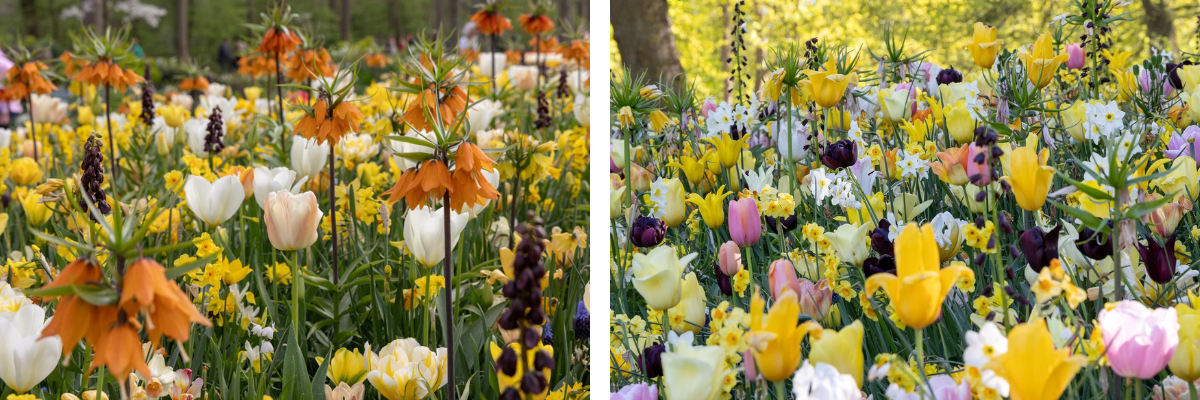
Van Boxtel, who is also a painter, approaches the border as a canvas composition. This is particularly evident in her use of dark accents. In The Field of Gold, both matte and glossy varieties of Fritillaria persica have been used, including the highly polished ‘Purple Dynamite’. “I got many questions about that,” she says. “For me, those differences function like paint. Matte black creates shadow, while glossy dark tones reflect light. Together, they add depth to the gold.”
Standout varieties in the composition include Tulipa ‘Apricot Pride’, which shifts from apricot pink to creamy white, blending a warm golden glow into the yellow, and the botanical Tulipa ‘Lucca’, a small yellow tulip with a dark heart that draws attention along the border edges. The assortment also demonstrates the breadth of the palette: tulips, daffodils, crocuses, fritillarias, irises, camassia and other naturalising bulbs follow one another from early March through to the end of May.
A bold case for yellow
According to Van Boxtel, The Field of Gold is her most daring design for JUB Holland to date. While yellow is popular in spring, it is often used cautiously in professional planting schemes — considered too bright, too harsh or too dominant. For that very reason, Van Boxtel chose not to tone it down, but to refine it. Apricot and peach soften the gold, while deep, dark tones introduce tension and shadow. The effect is warm, rich and layered — painterly rather than simply cheerful. Yellow takes on a new role: not as an accent, but as the foundation that allows other colours to resonate more strongly.
Landscape architect and contractor Ruud Vermeer of Meneer Vermeer Tuinen (NL) responded enthusiastically: “I always thought yellow and pink were an impossible combination. Once again, Carien van Boxtel has surpassed herself at Keukenhof for JUB Holland. Emotion, emotion and more emotion when you stand there.”
Keukenhof as showcase and design laboratory
JUB Holland has been an exhibitor at Keukenhof for many years. Each season, the family business from Noordwijkerhout (NL) not only supplies bulbs to the park, but also presents its own border design. Since 2019, these have been created annually by Carien van Boxtel, each with its own theme, palette and narrative. For JUB Holland, Keukenhof functions as both an international showcase and a design laboratory. Here, colour combinations, flowering times, heights, densities and plant selections are tested and experienced by a global audience.
Around seven million spring-flowering bulbs are planted in the park each year by Keukenhof’s forty gardeners, across 32 hectares. The JUB border itself is planted in three layers by a specialist team. For JUB Holland, this world-renowned show garden is quite literally on its doorstep: Lisse lies just around the corner from Noordwijkerhout, where the company’s nursery and headquarters are based.
From show border to collection
JUB Holland’s Keukenhof designs do not remain confined to the park. Each design forms the basis for a bulb mixture that becomes available the following year for landscape and retail clients. This allows municipalities, designers, contractors, garden centres and consumers to bring a piece of the Keukenhof experience into their own projects or sales environments. Van Boxtel deliberately combines familiar and more unusual varieties. The latter add tension, identity and refinement; the former ensure the mixtures remain practical, available and scalable beyond the Keukenhof context. The result is a collection that is both artistically distinctive and commercially viable.
That translation is already visible in practice. Previous JUB Holland mixtures designed for Keukenhof are now being applied in projects across the Netherlands and beyond. A notable example is the bastion in the city of Alkmaar (NL), where seasonal planting around the Molen van Piet (the iconic windmill of the city) adds colour, seasonal interest and public value to a historic urban setting.
An immersive planting experience
The emotional impact of The Field of Gold aligns with the philosophy of the late British garden designer Nigel Dunnett, an important source of inspiration for Van Boxtel. His planting designs focused not on replicating nature, but on enhancing it — creating dynamic, layered schemes that offer an immersive experience through colour, structure and seasonal change. “That’s always my aim as well,” Van Boxtel says. “A planting should be something you can step into — somewhere you can lose yourself for a moment.”
On display until 10 May
Visitors wishing to see The Field of Gold can do so at Keukenhof in Lisse (NL) until 10 May. After that, the park closes and, as every year, the border is lifted. Preparations for the next season begin in autumn — and Van Boxtel is already developing the first ideas for JUB Holland’s next design.


check out our socials


